


Use AI as a writing partner without letting it write your book
Research, brainstorming and fact-checks, yes. Your sentences, no. A practical way to work with AI and stay the writer.
Chris & Randy · 2 min read


AI writing tools have split into two camps. Some will write chapters for you. Others refuse to touch AI at all. Most writers we talk to want something in between: help getting unstuck, without a machine taking over the voice that makes the book theirs.
Here’s how to get that.
Decide what the AI is for
Give it jobs a good research assistant would do. Four work well:
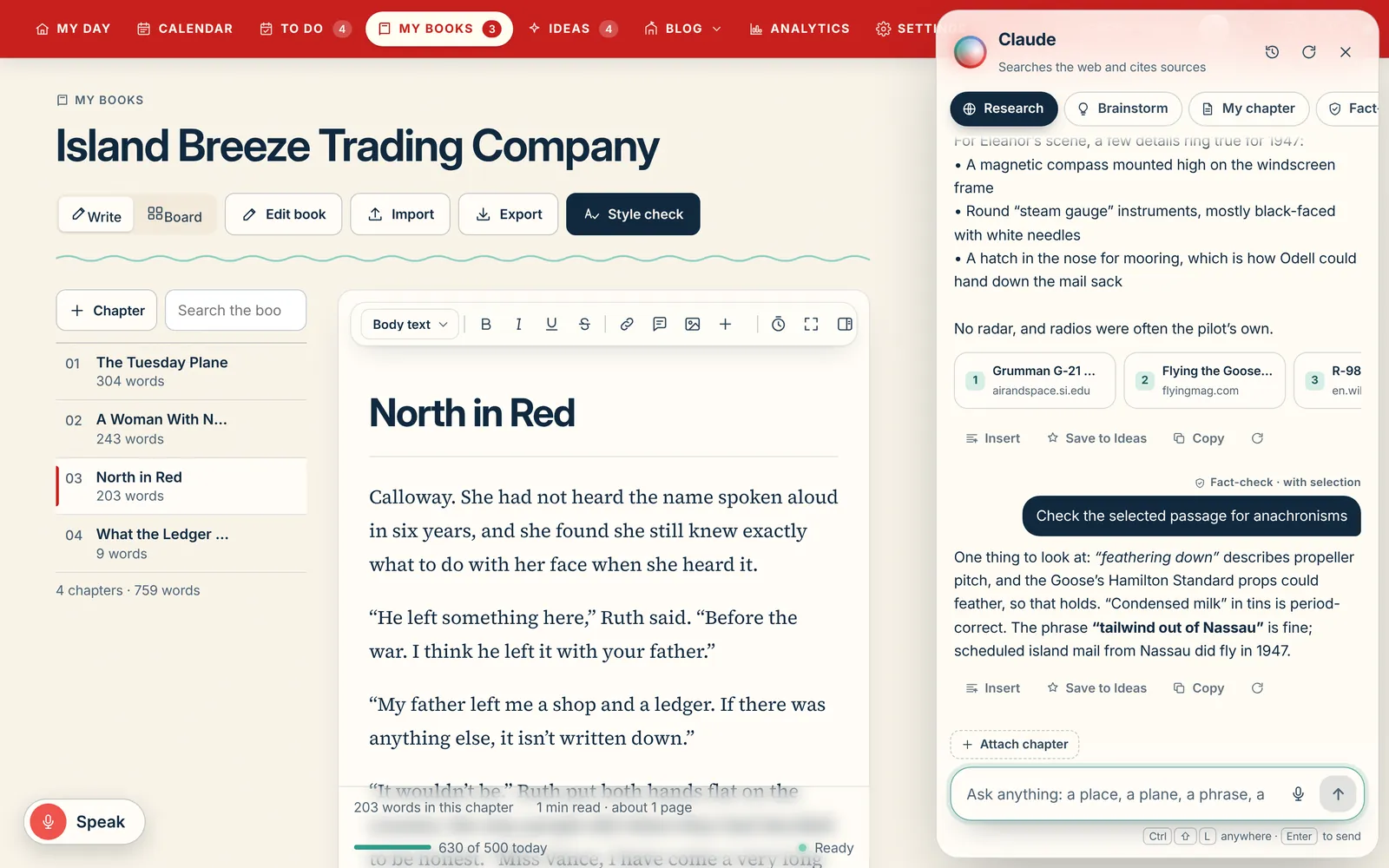
- Research. What a 1947 cockpit looked like, with sources you can open and check.
- Brainstorming. Five ways a scene could go when you’ve stared at it too long.
- Questions about your own chapter. What is this chapter really about? Where does the pace sag?
- Fact-checks. Would a character in 1952 really say that?
Keep the prose yours
Readers can feel when a voice goes flat. The safest rule is the simplest: the AI suggests, you write. In Salt of the Page, every answer waits beside the page, and nothing goes into the manuscript unless you put it there.
The AI won’t write your book. It’s there to keep the creative juices flowing.
Give it rules, not prompts
Most people get poor results from AI because it doesn’t know what kind of help a writer needs. You shouldn’t have to learn prompt-writing to fix that. We’ve written out the rules our assistant follows, and every AI you connect reads them before it answers:
- Help, never ghostwrite.
- Respect the author’s voice, period and point of view.
- Read the Source of Truth and the open chapter first.
- Show numbered, checkable sources.
- Leave the page alone.
- Keep answers short and useful.
Check the receipts
Any AI can be confidently wrong. Ask for sources, open them, and treat anything without one as a lead, not a fact. That’s why research answers in Salt of the Page come with numbered sources.
Bring your own AI, or none
Salt of the Page doesn’t sell AI. You connect the one you already like (Claude, ChatGPT or Gemini) with a key from your account with that company, and you pay them directly for what you use, usually a few dollars a month for writing help. A model running on your own computer through Ollama or LM Studio is free.
One thing that trips people up: a ChatGPT Plus or Claude Pro subscription isn’t the same as a key. A key is a separate pay-as-you-go account with the same company.
And if you’d rather not use AI at all, leave it off. The style check, the dictionary, the book previews and every export work without it.
Chris & Randy
A son and his dad who make Salt of the Page, book writing software for authors who want to finish. Questions about this post? Write to us.
About us